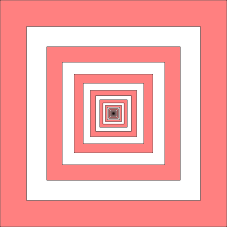
In the figure below, the outside square contains infinitely many squares, each of them with the same center and sides parallel to the outside square. The ratio of the side length of a square to the side length of the next inner square is $k$, where $0 \lt k \lt 1$. The spaces between squares are alternately shaded as shown in the figure (which is not necessarily drawn to scale).
$\textbf{(A) } \frac{3}{5} \qquad\textbf{(B) } \frac{16}{25} \qquad\textbf{(C) } \frac{2}{3} \qquad\textbf{(D) } \frac{3}{4} \qquad\textbf{(E) } \frac{4}{5}$
Difficulty: 36/100 — Fairly difficult if the contestant is not familiar with similarity or infinite geometric series, otherwise, it is a bit standard.
Core Concepts: similarity, geometric series
Challenges: Converting the area condition to an algebraic equality by capitalizing on the similarity.
Techniques: Notice that the infinite similarity encourages you to utilize a geometric series.
Error-prone Steps: Incorrectly finding the value of the sum of areas, incorrectly solving the quadratic.
Ideal Time:
Experienced: ≤ 1-2 min
Intermediate: ≤ 2 min
Beginner: ≤ 4 min