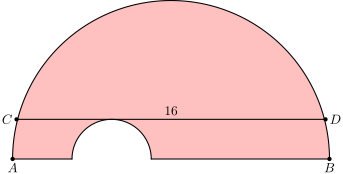
A semicircle has diameter $\overline{AB}$ and chord $\overline{CD}$ of length $16$ parallel to $\overline{AB}$. A smaller semicircle with diameter on $\overline{AB}$ and tangent to $\overline{CD}$ is cut from the larger semicircle, as shown below.
$\textbf{(A) } 16\pi \qquad\textbf{(B) } 24\pi \qquad\textbf{(C) } 32\pi \qquad\textbf{(D) } 48\pi \qquad\textbf{(E) } 64\pi$
Difficulty: 32/100 — With little information given in the problem, it may not be clear what course of action to take. Requires somewhat advanced chord knowledge.
Core Concepts: right triangle, circles, chords
Challenges: Recognize that the radii of both semicircles do not matter. Find a way to compute the area without directly being given a radius.
Techniques: Finding a general solution in terms of $R$. If unsure, make an assumption because of how vague the problem statement is.
Error-prone Steps: Forgetting to divide the area by two (semicircle vs. circle). Adding the areas of the semicircles instead of subtracting.
Ideal Time:
Experienced: ≤ 40 sec
Intermediate: ≤ 1-2 min
Beginner: ≤ 2-3 min